Why Can’t AI Fix Organizational Chaos on Its Own?
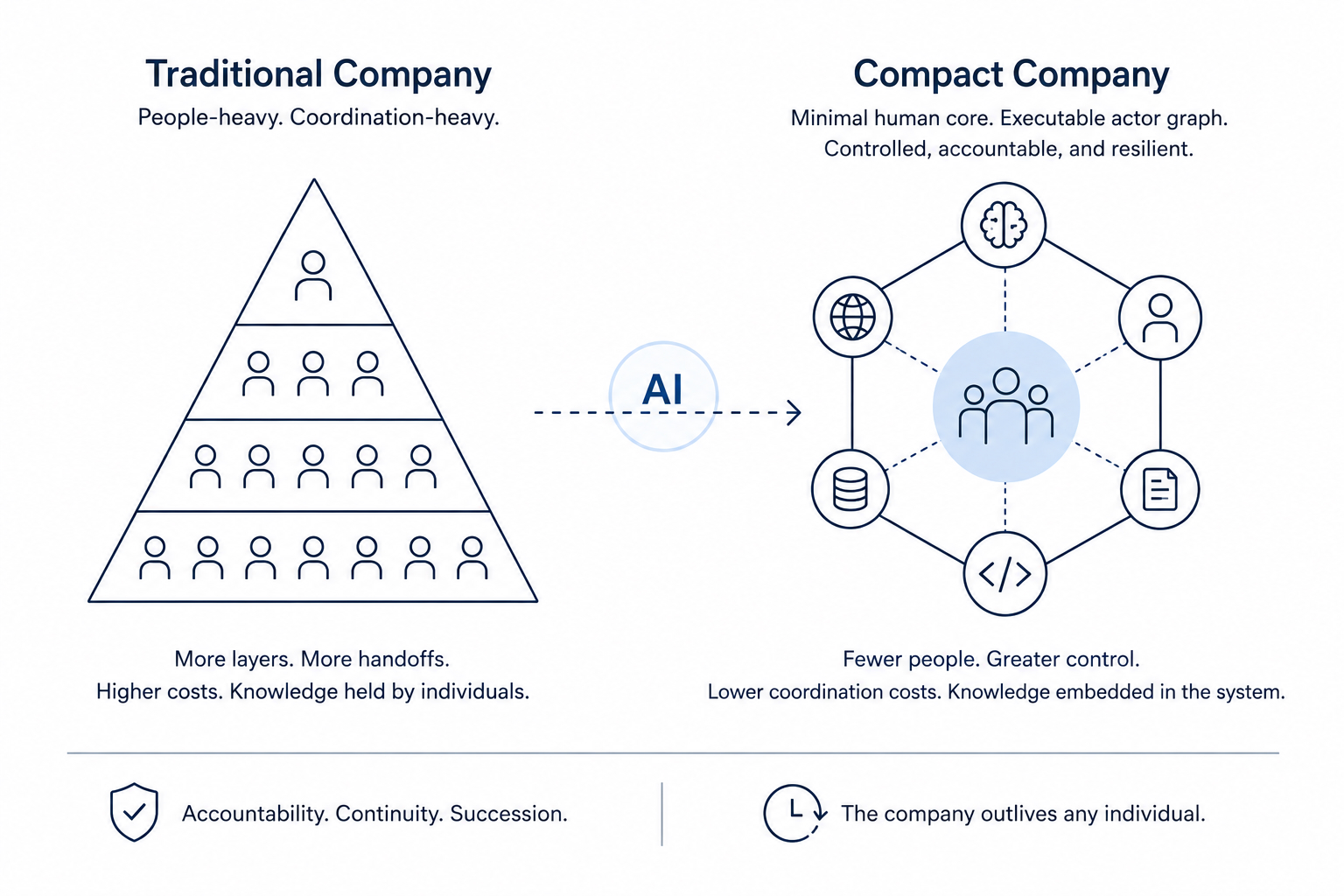
Companies are adding AI to already fragmented infrastructure. Each new tool introduces more interfaces, exceptions, and gaps in accountability. The result is familiar: coordination costs rise, decisions slow down, and critical knowledge remains locked inside individual employees.
LLMs can reduce coordination costs and shrink a company’s human core. Architecture preserves control, accountability, continuity, and the ability to operate beyond any single employee, founder, or technology provider.
In his new paper, "The Compact Company: An Actor-Graph Theory of the Firm in the LLM Era", our founder, Alexander Vityaz, introduces the Compact Company: a minimally sufficient human core organized around an executable graph of people, software, AI, and external participants, unified by a Digital Twin of the Organization.
This architecture enables a company to control more transactions with lower coordination overhead—without sacrificing accountability, operational control, or organizational resilience.